How simulations optimised the Kraftblock heat storage

An article from Cadfem Journal (author is Cadfem Journal. This is a copied Version with changed title. No advertisment)
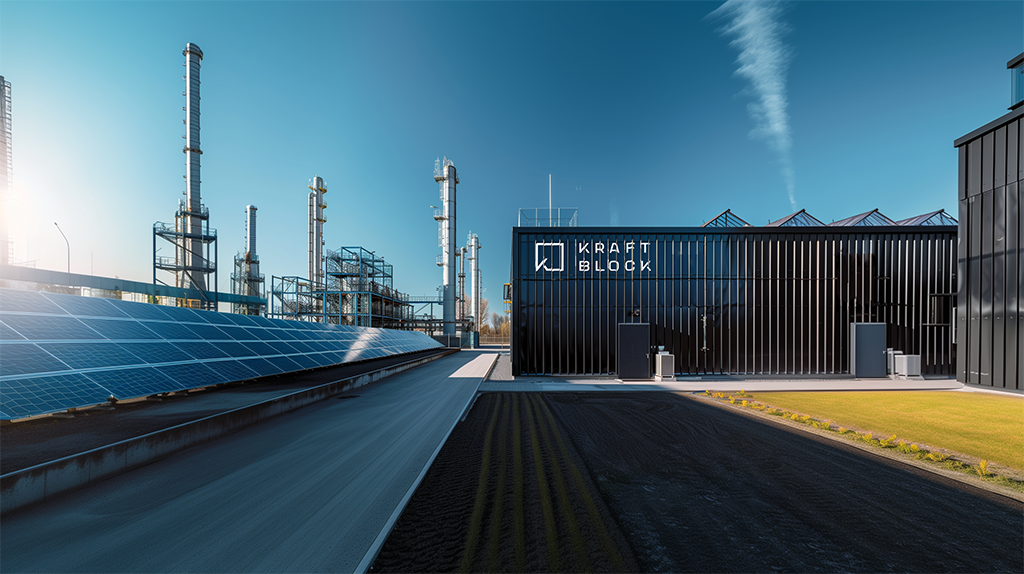
Through innovation, a young company from the Saarland is contributing to the decarbonization of industry: Kraftblock is the name of the scale-up and its product, which uses thermal storage technology for green energy. While the high-temperature heat storage systems were developed and optimized using FEM, CFD, and DEM simulations, digital twins will ensure their smooth and transparent operation in the future and enable new business models.
Kraftblock started small. Very small. That’s because chemist Martin Schichtel, who earned his Ph.D. at the Leibniz Institute for New Materials in Saarbruecken, was conducting research at the nanoscale on the storage material used in Kraftblock’s high-temperature heat storage systems. In 2014, he founded the company Kraftblock together with economist Dr. Susanne König. Their mission: to advance the decarbonization of industry through the innovative, efficient, and affordable provision of process heat derived primarily from renewable energy sources.
The research findings led to the key component of the heat battery - a granulate that stores energy as heat rather than electricity and is highly sustainable in the process: It requires no rare earth elements and consists of 85% recycled materials such as steel or glass slag, which are found in large quantities in landfills worldwide. This eliminates dependencies and bottlenecks; furthermore, the formula has been tested for up to 40 years. The granulate is used in a container-like housing. This is the “Kraftblock,” the high-temperature heat storage unit, named after its manufacturer. It can absorb energy and store it for up to two weeks before the heat is retrieved “on demand.” The advantages: Waste heat from production processes is conserved, and energy from renewable sources is purchased when it is inexpensive. This benefits energy-intensive industrial sectors whose process heat has previously come mainly from fossil fuels.
“Our core model is to respond quickly and accurately to the energy market, thereby securing the most favorable prices for flexible process heat. To operate optimally, we need accurate simulations and predictions of how our storage system will behave in every charging scenario.” Martin Schichtel, CEO & Co-Founder Kraftblock
Maximum Efficiency Through In-Depth Simulation with Ansys and CADFEM
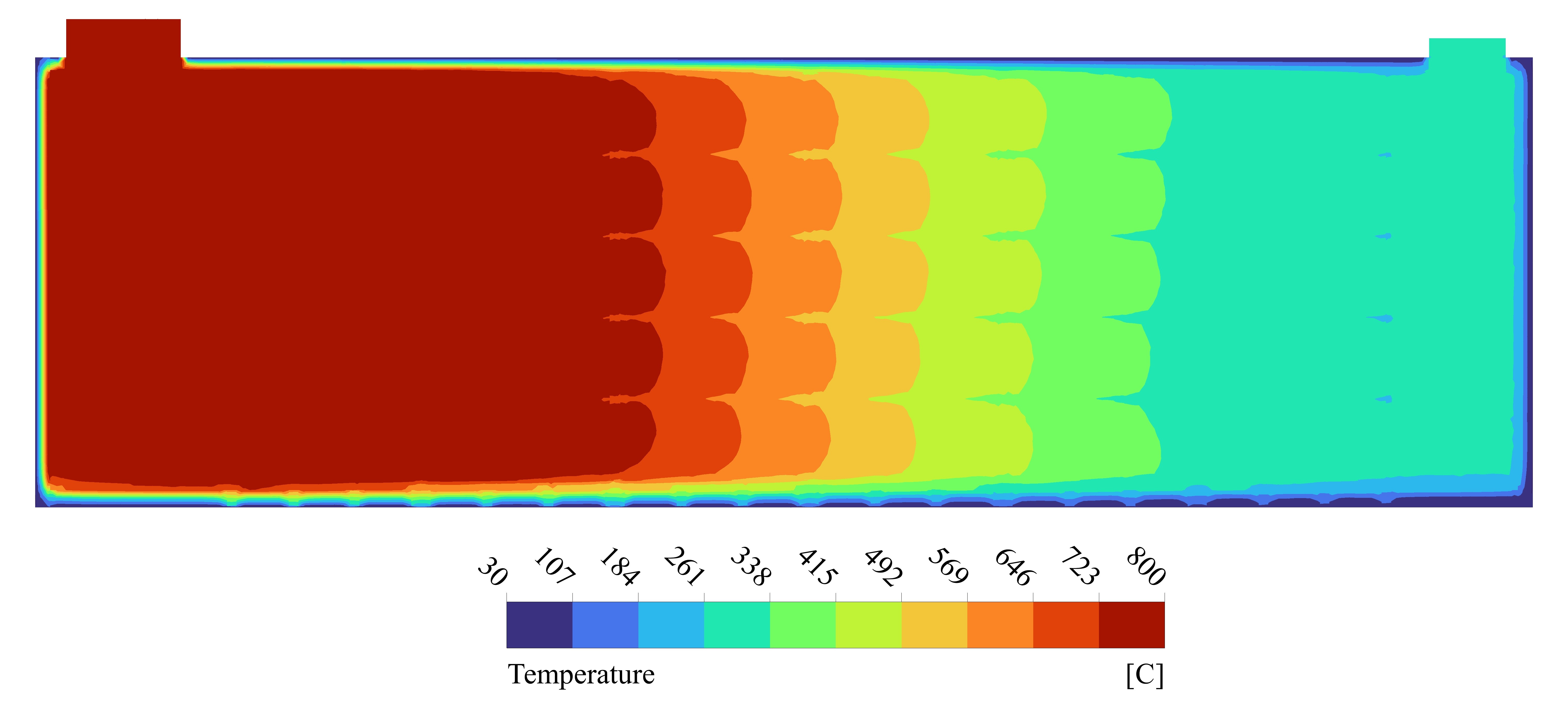
At first glance, the technical process in a Kraftblock is very simple: Heat from waste heat or converted renewable energy is blown into the storage unit, where the granules absorb it. The heat remains stored for hours or even several days until it is needed for production processes. Cold air is then blown into the storage unit; this air heats up as it encounters the material and is fed to the application area in the required form as process heat.
What sounds simple is, from a physical standpoint, a complex interplay of heat transfer with structural and fluid dynamics processes and particle interactions. To gain a thorough understanding, identify key parameters, and optimize them, Kraftblock uses Ansys tools for simulation. With Dr. Stephan Rother and his team, Kraftblock has highly experienced in-house experts in this field, who are supported by specialists from CADFEM as needed.
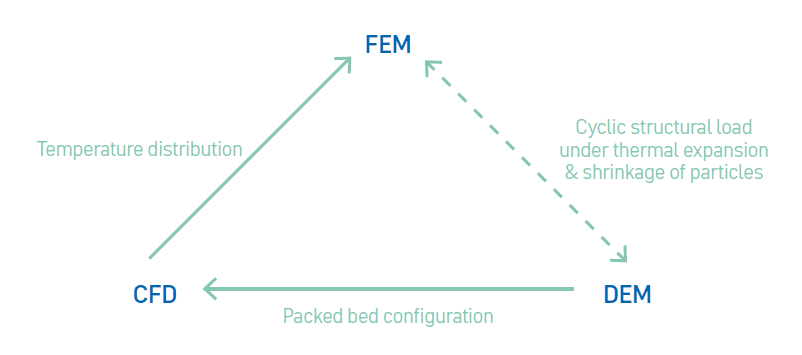
Kraftblock also obtains Ansys software from CADFEM. Ansys Mechanical is used for many structural and thermal simulations and optimizations. These range from small and large deformations to contact and buckling analyses, studies of the Kraftblock’s behavior during earthquakes, and thermal analyses related to insulation. For CFD calculations, Kraftblock relies on Ansys Fluent and Ansys CFX. These calculations typically involve simulating airflow behavior and heat transfer within the porous medium - that is, the interaction with the material and structure. As every detail matters here, the models are very large and are solved using GPU technology and an HPC cluster with 8 cores.
Ansys Rocky is used to simulate the settlement behavior and packing density of the storage granules based on the Discrete Element Method (DEM). This helps the Kraftblock team analyze the behavior of the storage material and its distribution, and optimize its allocation in relation to flow processes and structural behavior.
During its simulations in various domains, including multiphysics, Kraftblock benefited in the early years from the Ansys Startup Program, which provides access to many Ansys tools. CADFEM also provides additional support through seminars, technical support, and consulting services. In addition, CADFEM serves as a sparring partner for the technical Kraftblock team in evaluating new areas of application - such as simulation-based digital twins.
Transparency for Everyone: Digital Twin Brings Clarity
A new project being led by the Kraftblock team and Stephan Rother in collaboration with CADFEM demonstrates that simulation at Kraftblock now goes beyond the analysis and optimization of physical properties and relationships. The third partner in this collaboration is ITficient AG. It focuses on the ongoing operation of the storage system. Its behavior is to be accurately modeled in a virtual environment by integrating data from various sources and IT tools. This digital twin is a fully digitized product system that enables real-time condition monitoring and thus delivers genuine added value for plant operators.
“The multi-step approach taken on the path to a digital twin includes improving the accuracy of 3D CFD simulations, AI-based model reduction, and the continuous adaptation of the reduced model based on measurement data. This is intended to enable a highly accurate, real-time representation of system behavior.” Stephan Rother, Simulation Engineer, Kraftblock.
Reaching the Goal in Four Steps with CADFEM and ITficient.
CADFEM and ITficient have already developed digital twins for and in collaboration with various clients. A four-step approach has proven effective for guiding clients through the entire process, from concept to implementation. Each of the four project steps begins with a workshop that has a clear objective:
1. Analysis of the current state, objectives, and identification of a suitable use case
2. Focus on the technology landscape, processes, and data sources
3. Focus on existing vs. required IT and testing infrastructure
4. Detailed technical concept and roadmap for implementation
A Relevant Use Case: State of Charge
A Kraftblock is a thermal battery and therefore shares a characteristic found in conventional batteries: its exact state of charge is unclear without the use of additional tools. Because this information is essential for operators, sensors are built into the Kraftblock to determine its state of charge.
The crux of the matter: Sensors can only be replaced with considerable effort; if they fail, the information on the state of charge becomes less accurate, and efficient operation is compromised. It was precisely in this scenario that the specific use case to be mplemented in the Volt project was identified: In this project, the Dutch energy provider Eneco is installing a Kraftblock system at PepsiCo to decarbonize food production. For this facility, a prototype of a digital Kraftblock twin is to be developed that reliably displays the current state of charge. This will be achieved using virtual sensors that supplement or even replace existing physical sensors.
If this is successful, various stakeholders will benefit:
- The operator of the Eneco storage system, in controlling the heat supply for production.
- Eneco’s management, in monitoring and optimizing processes.
This use case is also of interest to Kraftblock itself, as it is one of the keys to its own new business models, such as “Heat-as-a-Service.”
Digital Twins as the Key to Heat-as-a-Service
Heat-as-a-Service is about offering customers an alternative to purchasing energy storage systems. Instead of purchasing a storage system, the customer acquires heat supply contracts tailored to their needs. This model requires knowledge of the exact state of charge. Only then can steam, thermal oil, or hot air be supplied at the specified temperature and with the required mass flow within a defined time window. Responsibility for this lies with Kraftblock as the system supplier, which requires reliable condition monitoring.
The technical Kraftblock team is working on the digital twin together with colleagues from the new Energy Services division, as well as with CADFEM and ITficient. Following the roadmap developed during workshops within this group, the sensors’ behavior within Kraftblock is modeled based on the available data - much of which comes from previous FEM, CFD, and DEM simulations. The validation, consolidation, and derivation of sensitivities are followed by system simulations, which are then integrated with the appropriate IT infrastructure.
Kraftblock expects to complete the first operational twin for Eneco Volt in the spring of 2027. Once developed for the initial use case, it can be scaled and tailored to accommodate future Heat-as-a-Service contracts and their specific requirements within the framework of the new business model.
Read more about Cadfem's Digital Twin here: https://www.cadfem.net/en/industries-topics/topics/digital-twins.html