How to electrify the pulp and paper industry with Thermal Energy Storage

.jpg)
Every year, the global pulp and paper industry transforms vast quantities of raw fiber into essential products packaging, hygiene materials, specialty papers, and board grades. In 2024 alone, global pulp production reached 190.07 million metric tons6, while paper and paperboard production exceeded 423 million metric tons.7 Behind these everyday materials lies one of the most thermally intensive industrial systems in operation today - one that takes up 9% of the USA’s industrial energy consumption.8
From wood handling to high-speed drying cylinders, pulp and paper mills operate as tightly integrated energy ecosystems consuming steam, electricity, biomass, and processing heat in continuous industrial flows. Understanding where this energy is used and how it is recovered and how it can be electrified is key to transforming one of the biggest industries and their carbon footprint.
Despite internal recovery, the pulp and paper industry remains one of the largest industrial energy consumers worldwide. Total global energy use is estimated at ~6.7 EJ per year (1,861 TWh approx.).8 More than half of Europe’s pulp and paper energy demand (55%) is covered by biomass, with natural gas accounting for most of the remainder.13 This natural gas can be easily and economically replaced by electrification and Thermal Energy Storage System like Kraftblock.
What is the energy used in the process of making paper?
Paper production starts with cellulose fiber.¹ While wood remains the dominant raw material, recycled paper and agricultural residues such as bagasse or bamboo also contribute to the material base.
The transformation from raw wood to finished sheet follows a structured industrial chain. As illustrated in the figure below, the process begins with raw material preparation, debarking, chipping, and cleaning before entering pulping, washing, bleaching, stock preparation, and finally papermaking.¹
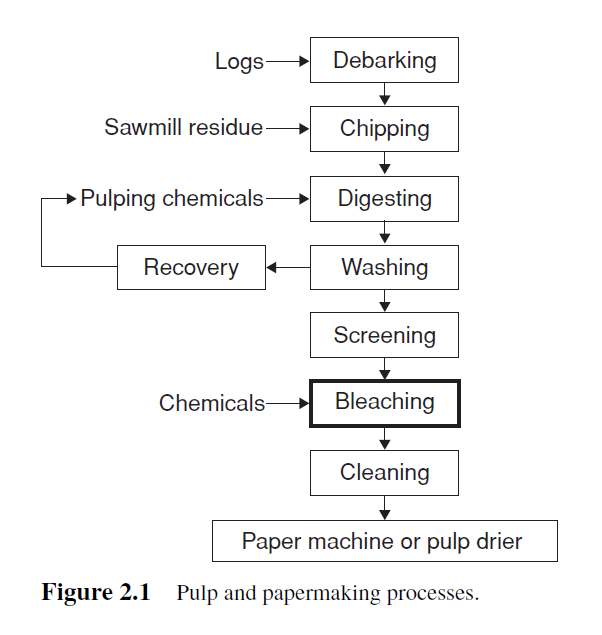
At the heart of the system lies pulping the separation of cellulose fibers from lignin. Three primary pulping routes are used:
- Mechanical pulping
- Chemimechanical pulping
- Chemical pulping (primarily the Kraft process)13
Mechanical pulping relies heavily on electrical energy to physically separate fibers. Most of that electricity is ultimately converted into heat.5 Chemical pulping, in contrast, removes lignin through chemical reactions unlocking a unique energy recovery method: black liquor.
How energy is generated and needed in pulp mills
Rather than being discarded after the Kraft process, black liquor becomes a primary energy source. It is is concentrated and burned in a recovery boiler, generating high-pressure steam that drives turbines and provides process heat.10 A 1,000-tonne-per-day Kraft pulp mill can generate 25–35 MW of electricity from black liquor combustion alone.1 This internal recovery loop explains why integrated mills can achieve up to 95% energy self-sufficiency.4

An integrated mill is not just a production site, it is a combined pulp plant, paper factory, and thermal power station operating as a single system. Standalone paper mills, by contrast, purchase dried market pulp and lack this internal recovery structure.4 Globally, approximately 16% of pulp production comes from standalone mills, while about 25% is produced in integrated mills.11 In Europe, only 18% of mills are integrated facilities.12
Therefore, a large part of the energy is not self-produced of biomass, but needs to be transformed with solutions that use clean electricity at times of low prices and at the same time serve the grid: Thermal Energy Storage.
Where can help Thermal Energy Storage the paper industry the most?
The pulp and paper mill operates as a complex thermal network. Core heat-generating systems include Recovery boilers (black liquor combustion)1, Lime kilns for chemical regeneration1, Natural gas boilers8, Multi-stage evaporation systems and Steam-heated dryer cylinders. While pulping requires substantial energy, the true thermal driver of paper production is drying. After mechanical pressing removes part of the water from the paper web, significant moisture remains. Large steam-heated cylinders evaporate this residual water in the dryer section of the paper machine.1
Energy demand per tonne of paper typically ranges between 1,400 and 2,400 kWh, depending on grade.2 In Germany (2021), production required 2,646 kWh per tonne, including 760 kWh electricity and 1,890 kWh steam.3 Drying alone can account for roughly 45% of total papermaking energy consumption.14 The transition from a fossil-fired boiler that generates steam to clean electricity is rather easy and the existing infrastructure can be used. Electricity is bought when cheap or when PV and wind power is available and stored as heat. Then steam is generated continuously to supply the drying process. Typical parameters here lie within 130-180 °C and 3-10 bar pressure.
Additionally there is a hood drying system supplying a lot of air between 80 - 120 °C for removing moisture. For Kraftblock’s system this is a use case as well, as it can supply air directly out of the system at high temperatures.
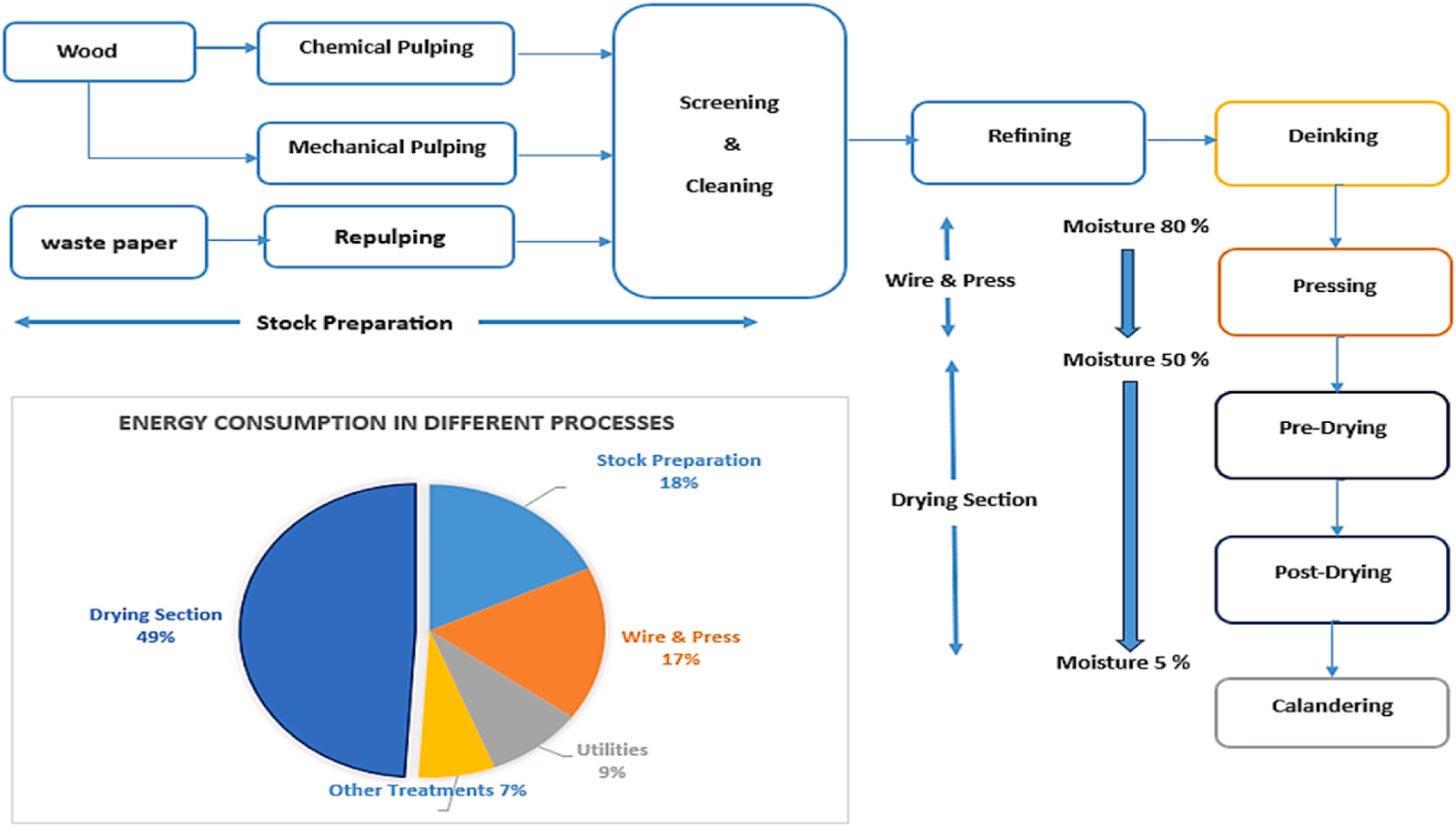
Depending on the paper grade, additional drying stages may be implemented. Pre-drying and post-drying sections can reach heat demands of 6–9 GJ per tonne.14 Tissue machines, in particular, may include Yankee cylinders combined with high-temperature hood systems and impingement air drying, significantly increasing thermal intensity. The drying section need to have a reliable condensate recovery and also may have integrated heat recovery systems in the hood.
In integrated mills, internal biomass-based steam generation reduces fossil fuel exposure. In non-integrated mills, where steam is typically gas-fired, drying represents the primary lever for decarbonization.8,13
Energy Profiles Across Pulping Routes
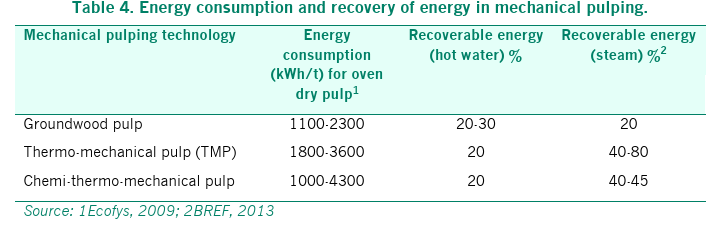
Energy intensity varies significantly between pulping technologies. Mechanical pulping typically consumes 1,100–4,300 kWh per tonne (oven-dry pulp).13 Electricity dominates the energy mix. Chemical (Kraft) pulping shows a different pattern with Cooking (~ 15% of total energy demand), evaporation (~30%) and pulp drying (~20%) being intense thermal processes. Electricity demand generally ranges between 600–800 kWh per tonne, while heat demand reaches 2,777–3,888 kWh per air-dry tonne.13
In integrated mills, pulp drying can sometimes be avoided entirely because pulp is processed directly into paper¹³ reducing overall thermal load. As pulp production is almost self-sufficient due to the use of black liquor as energy source, there is little optimisation to do. One is recovery waste heat from lime kilns and using it for steam generation, drying processes or preheating combustion air increasing overall energy efficiency and reduce a part of the emissions.
The lime kiln is a central unit in the Kraft pulping process, responsible for regenerating calcium oxide (CaO) from lime mud (CaCO3) and thereby closing the chemical recovery cycle.1 The process is based on calcination which requires high temperatures typically above 800–900 °C, with industrial operation often approaching 1000 °C to ensure efficient conversion.15 The kiln is usually a rotary drum.16 Heat is supplied through direct combustion, most commonly using natural gas or fuel oil, although biomass and alternative fuels are increasingly considered.17
From an energy perspective, the lime kiln is one of the most fuel intensive units in a pulp mill and is often the largest single consumer of fossil fuels, even in otherwise biomass based integrated mills.17 While a complete decarbonisation is challenging, energy efficiency improvements such as heat recovery can reduce energy demand. Deep emission reductions require fuel switching or advanced technologies.18 Consequently, unlike drying or evaporation processes, the lime kiln represents a hard to abate high temperature process, where conventional hot air systems are insufficient to fully replace fossil based heating.
While in pulp, some replacement of fossil fuels may be individual to sites and not a general option, drying sections in paper mills are a huge chance for decarbonisation and cost-efficient electrification with Krafbtlock.
References
- Overview of Pulp and Papermaking Processes – Accessed: 08.02.2026 | https://onlinelibrary.wiley.com/doi/epdf/10.1002/9780470649657.ch2?saml_referrer
- Dekarbonisierung der Papierindustrie – Accessed: 08.02.2026 | https://pathtozero.de/studie-dekarbonisierung-der-papierindustrie/
- Modellfabrik Papier gGmbH – Accessed: 08.02.206 | https://modellfabrikpapier.de/
- The Basics of Paper-making – Part 1: Integrated and non-integrated paper mills - Accessed: 11.02.2026 | https://www.billerud.com/globalassets/billerudkorsnas/our-offer/served-industries/medical--hygiene/blog/5.-integrated-and-non-integrated-mill-dl.pdf
- Simplified model of integrated paper mill for optimal bidding in energy and reserve markets - Accessed: 11.02.2026 | https://www.sciencedirect.com/science/article/pii/S0306261920313313
- Statista : Production of pulp for paper worldwide from 1961 to 2024 - Accessed: 11.02.2026 | https://www.statista.com/statistics/1333405/pulp-for-paper-production-worldwide/
- Production volume of paper and paperboard worldwide from 1961 to 2024 - Accessed: 11.02.2026 | https://www.statista.com/statistics/270314/global-paper-and-cardboard-production/
- The role of the pulp and paper industry in achieving net zero U.S. CO2 emissions in 2050 - Accessed: 11.02.2026 | https://www.sciencedirect.com/science/article/pii/S2666278724000369
- Energy efficiency at the paper mill—dilemma of improvement - Accessed: 11.02.2026 | https://link.springer.com/article/10.1007/s12053-016-9490-3
- Integrated kraft pulp and paper mill - Accessed: 11.02.2026 | https://www.naturvardsverket.se/49e80b/contentassets/5e6868a0080643a1b0bfb84c6c023339/3-kraft-integr-pm-eng-241129.pdf
- TIG White Paper: Global Wood Pulp Market Structure and Dynamics - Accessed: 11.02.2026 | https://timberlandinvestmentgroup.com/wp-content/uploads/2024/09/TIG-White-Paper-Global-Wood-Pulp-Market-Structure-and-Dynamics.pdf
- Decarbonization pathways for the pulp and paper industry: A comprehensive review - Accessed: 13.02.2026 | https://www.sciencedirect.com/science/article/pii/S1364032125007439
- Methodology for the free allocation of emission allowances in the EU ETS post 2012 - Accessed: 11.02.2026 | https://climate.ec.europa.eu/system/files/2016-11/bm_study-pulp_and_paper_en.pdf
- The pulp and paper overview paper - Accessed: 13.02.206 | https://www.diw.de/documents/dokumentenarchiv/17/diw_01.c.534645.de/cs-pulp-and-paper.pdf