How the ceramic industry can transition to clean energy


The ceramics industry, one of the historical pillars of the non-metallic manufacturing sector, ranges from construction materials, sanitary ware, and tableware to artistic ceramics and high-performance technical ceramics. It is also one of the industrial sectors with the highest demand for medium- and high-temperature thermal energy. Products such as tiles, bricks, roof tiles, refractories, and technical ceramics all require drying and firing processes that demand temperatures between 150 °C and over 1,200 °C, with natural gas as the almost exclusive energy source. This sector faces a double global challenge: its enormous energy consumption, around 182 TWh of natural gas per year, and its high carbon footprint, exceeding 400 million tons of CO₂ per year, which places it at the center of energy and climate debates, beyond its relevance in the construction market.
This article analyzes the challenges facing the ceramic sector and explores opportunities to improve its energy efficiency, such as waste heat recovery and the electrification of its production processes.
What is the challenge of Decarbonization in Ceramics
According to Cerame-Unie's classification, the European ceramics industry is divided into nine main segments: bricks and tiles, refractory materials, clay pipes, flower pots, tableware and ornamental ceramics, technical ceramics, sanitary ware, wall and floor tiles, and expanded clay. Tiles, bricks, and refractories alone account for around 90% of sector emissions in the EU.1 2
From a technical perspective, ceramic manufacturing stands out as one of the most energy-intensive industrial sectors, primarily due to its reliance on high-temperature thermal processes with firing in roller kilns at temperatures exceeding 1,200 °C, making energy one of the main cost components and a significant source of CO₂ emissions. Between 88% and 92% of the industry’s total energy demand is thermal, predominantly met through the direct combustion of natural gas, while electricity serves only a secondary role, powering motors and machinery.3 4
In the European Union, the energy intensity of ceramic production is particularly distinctive: manufacturing one tonne of ceramic tiles requires approximately 6 GJ (1.67 MWh), with the firing process alone accounting for roughly 55% of total thermal energy consumption. This translates to an average thermal energy use of about 1.28 kWh per kilogram of fired tile (based on Lower Heating Value, LHV 56. Such figures and heavy dependence on fossil fuels not only underscores the urgency of integrating renewable energy sources but also exposes the sector to significant cost to energy price fluctuations and its critical role in the broader challenges of competitiveness, decarbonization, and compliance with European climate and industrial policies.
Within this general framework, traditional ceramics is not a homogeneous market, but rather presents very different profiles depending on the type of product and its function in the economy. The Industry Research report shows that the market is composed of clearly differentiated segments, each with specific dynamics of production, competition, and added value.7
What are the emissions of the ceramic industry
The ceramic industry's heavy dependence on energy translates into a significant environmental footprint on a global scale. Global ceramic production is responsible for more than 400 million tons of CO₂ annually, led by China. Here, brick manufacturing alone resulted in 84 million tons of CO₂ (2005).
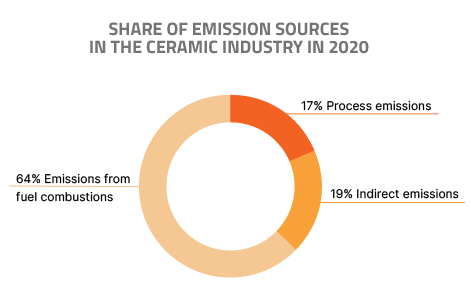
Within the European Union, the industrial ceramics sector emits around 19 million tons of CO₂ per year, representing approximately 1% of industrial emissions covered by the Emissions Trading Scheme (ETS). Of this total, 64% corresponds to fuel combustion, 19% to electricity consumption, and 17% to process emissions, which reached 3.34 million tons of CO₂ in 2019. In certain sub-segments, such as bricks, process emissions can account for between 30% and 60% of the total.2
In addition to CO₂, ceramic manufacturing generates a wide range of air pollutants. According to the US Environmental Protection Agency (USEPA), ceramic tile production emits an average of 300 kg of CO₂ per ton, along with other pollutants such as CO, NO₂, SO₂, and HF.8,9
The predominant combustion of natural gas translates into a high share of energy costs in the total production costs. According to sector analyses of the ceramic sanitaryware market 10, energy accounts for around 33% of total production costs, making it the single most critical competitiveness factor in global markets. 71% of total energy costs are linked to natural gas consumption and the firing phase alone representing more than half of total gas use, followed by spray drying 11 . Decarbonising the sector needs to come along with cost-efficient solutions in order to maintain economical survival of the industry. This means solution like Kraftblock cutting costs tremendously in the transition are the key to emission reduction and successful electrification.
How to electrify the Ceramic Industry
Deep decarbonization of the ceramic sector requires a multifaceted approach: electrification of high-temperature heat processes, scaling up renewable and low-carbon fuels (e.g., hydrogen and biofuels), and maximizing waste heat recovery (preferably using air or thermal oil systems over water). However, this transition is complicated by multiple factors: rising compliance costs, stricter limits on kiln emissions, water restrictions, volatile gas prices, and the structural fragmentation of the industry, which places disproportionate burdens on SMEs. 2,3,12
Electrification, especially for the firing process, stands out so far as is a proven technological route to decarbonization. It has the potential to eliminate direct combustion emissions and substantially boost efficiency. Consequently, the industry's future energy mix will be shaped not only by process innovations but also by the availability of low-carbon electricity at an industrial scale.
How can the process steps in ceramics be electrified?
Ceramic production, as detailed in the Ceramic Roadmap to 2050 by Cerame-Unie 2 is a controlled process of mineral transformation. It primarily relies on mined resources such as clay, bauxite, and magnesite. The process steps are consistent across all regions: preparation of raw materials, shaping (typically via pressing), drying, glazing, and final high-temperature firing. Firing and the subsequent thermal transformations are the dominant stages in terms of energy consumption.
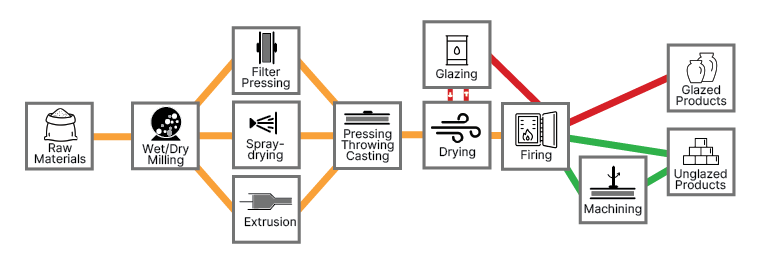
Specifically, ceramic tile production typically consists of five main steps.13
1. Raw Material Preparation
The initial stage involves the grinding and mixing of raw materials and additives to create a material slurry. This preparation, including body and glaze milling, is an electrically intensive operation.
2. Spray Drying
Once the slurry is prepared, it is subsequently transformed into a free-flowing, granulated powder suitable for pressing through spray drying. This process atomizes the slurry and exposes it to high-temperature air (typically 500–600 °C) 14 for rapid moisture evaporation. From a thermal energy perspective, this is a highly demanding stage, accounting for approximately 36% of total thermal energy consumption in tile production, according to a review in Sustainability (MDPI) 15. This process can be especially easily matched with electrification solutions like Kraftblock: The hot air is supplied from the thermal storage that was charged before with clean electricity from cheap times. This combines cost-efficiency with no impact on the production route.
3. Shaping
The prepared powder is shaped, most commonly by pressing in steel molds to form a "green body" (unfired ceramic). For products like sanitary ware, shaping is achieved through casting into plaster molds before drying and glazing 16.
4. Drying of Formed Body
The green body contains residual moisture that must be carefully removed to prevent warping or cracking. This drying stage operates at lower temperatures, typically 150–250 °C, and involves pure water evaporation. It accounts for about 9% of the total thermal energy use, according to the MDPI and the Iberdrola reports. Drying of the body can also be done with energy from thermal storage without any technical question marks.
5. Firing (Core Transformation)
Firing is the critical, final step that drives the ceramic body's transformation through dehydration, carbonate decomposition, phase changes, and sintering reactions, leading to densification. This stage consumes the majority of thermal energy, approximately 55% of the total. In single firing (monocottura) tile production, the body and glaze are simultaneously fired at very high temperatures, usually 1100–1200 °C. Glazing may occur before or after drying, depending on the product family. In sanitary ware, glazing is applied to the dried body before final firing (ScienceDirect link above).
Firing is carried out in either intermittent (batch) or continuous kilns, depending on product type and production scale. Continuous kilns operate continuously and must therefore be loaded and unloaded around the clock, requiring either 24-hour staffing or automated buffering systems. Batch kilns, by contrast operate intermittently, can be shut down between cycles, and are more flexible but less energy efficient.
6. Finishing
Following firing, the ceramics may undergo final operations, including polishing, rectification, surface treatments, and quality inspection.
While variations exist based on product type, raw materials, and specific methods, the fundamental thermodynamic logic remains constant. From a decarbonization and engineering standpoint, the distribution of energy demand is key.

How does Thermal Storage help the Ceramic Industry?
In spray drying and body drying the use of heat from thermal energy is a clear potential to use low-price electricity from some hours of the day for the use of the production later. A review published by Queen’s University Belfast 3 estimates that in the EU, 78% of energy demand is electrifiable with currently available technologies, and 99% could be electrified with technologies under development. Electrification options include:
- Electric kilns
- Electric heaters (as used by Kraftblock)
- Microwave drying in the future, as currently TRL 3 (More here and here)
- Hybrid systems integrating electricity and hydrogen like in the eLITHE Project program (under the condition that hydrogen becomes feasible at some point)
However, the same review stresses that electrifying large high-temperature kilns remains a “huge challenge” and requires further investigation for industrial-scale applications, especially due to high electricity costs using direct electrical equipment. A partial electrification of kilns using hot air from a Kraftblock system topped off by the gas burners in use could be an economic step towards fully electrical kilns.
Fossil fuel and its price remain the dominant reason for the sector to be hesitant with starting to electrify their production. How Kraftblock can cut prices by utilizing its storage unit on the electricity market is shown in this Whitepaper.
Future: Energy efficiency in the ceramic sector does not only reduce costs but also the emissions of saved gas. In a second article, we take a look at how waste heat recovery and thermal storage can impact the ceramic sector.
References:
1European Comission: Single Market Economy. Ceramics. Online: https://single-market-economy.ec.europa.eu/sectors/raw-materials/related-industries/non-metallic-products-and-industries/ceramics_en
2Cerame-Unie. The European Ceramic Industry Asociation. https://www.ceramicroadmap2050.eu/wp-content/uploads/2024/01/ceramic-roadmap-to-2050.pdf
3Queen's University Belfast. Decarbonizing the ceramics industry: A systematic and critical review of policy options, developments and sociotechnical systems https://pureadmin.qub.ac.uk/ws/portalfiles/portal/288308212/Ceramics_V2FV.pdf
4Ana Mezquita, Juan Boix, Eliseo Monfort, Gustavo Mallol, Energy saving in ceramic tile kilns: Cooling gas heat recovery, Applied Thermal Engineering, Volume 65, Issues 1–2, 2014, Pages 102-110, ISSN 1359-4311, https://www.sciencedirect.com/science/article/pii/S1359431114000088
5European Comission: Design for Resource and Energy efficiency in cerAMic kilns. Online: https://cordis.europa.eu/project/id/723641/reporting
6International Energy Agency(IEA). Tracking Industrial Energy Efficiency and CO2 Emissions. 2023. Online: https://iea.blob.core.windows.net/assets/84e31bc6-6ebd-4026-9060-3c9ae64e4c11/tracking_emissions.pdf
7Industry Research. (2026). Traditional ceramics market size, share, growth, and industry analysis. https://www.industryresearch.biz/market-reports/traditional-ceramics-market-114358
8Vijerathne DT, Wahala SB and Asmone AS (2025) Advancing environmental sustainability of ceramic tile production: a cradle-to-gate life cycle assessment case study from Sri Lanka. Front. Built Environ. 11:1654253. doi: 10.3389/fbuil.2025.1654253 https://www.frontiersin.org/journals/built-environment/articles/10.3389/fbuil.2025.1654253/full
9European Industrial Production Information Exchange (EIPIE). Manufacturing Industry (CER BREF) https://eipie.eu/the-sevilla-process/brefs/ceramic-manufacturing-industry-cer-bref/
10Verified Market Research. (2025, October 27). Ceramic sanitary ware market is expected to generate a revenue of USD 55.99 billion by 2032, globally, at 6.6% CAGR. GlobeNewswire. https://www.globenewswire.com/news-release/2025/10/27/3174762/0/en/Ceramic-Sanitary-Ware-Market-is-expected-to-generate-a-revenue-of-USD-55-99-Billion-by-2032-Globally-at-6-6-CAGR-Verified-Market-Research.html
11Ancona MA, Branchini L, Ottaviano S, Bignozzi MC, Ferrari B, Mazzanti B, Salvio M, Toro C, Martini F, Benedetti M. Energy and Environmental Assessment of Cogeneration in Ceramic Tiles Industry. Energies. 2023; 16(1):182. https://doi.org/10.3390/en16010182
12European Comission: Making ceramic tile production greener with reused heat. Online: https://cordis.europa.eu/article/id/411496-making-ceramic-tile-production-greener-with-reused-heat
13Hussam Jouhara, Navid Khordehgah, Sulaiman Almahmoud, Bertrand Delpech, Amisha Chauhan, Savvas A. Tassou. Waste heat recovery technologies and applications. Thermal Science and Engineering Progress, Volume 6, 2018, Pages 268-289, ISSN 2451-9049, https://www.sciencedirect.com/science/article/pii/S2451904918300015
14Iberdrola España. (2025). Estimación de las necesidades eléctricas del sector cerámico de Castellón para planificar la adecuación de las infraestructuras eléctricas. Informe público. https://www.iberdrolaespana.com/documents/d/sesp/informe-publico-estimacion-necesidades-electricas-sector-ceramico-castellon
15Branca TA, Fornai B, Colla V, Pistelli MI, Faraci EL, Cirilli F, Schröder AJ. Industrial Symbiosis and Energy Efficiency in European Process Industries: A Review. Sustainability. 2021; 13(16):9159. https://doi.org/10.3390/su13169159
16Kai Ding, Anjie Li, Jingxiang Lv, Fu Gu, Decarbonizing ceramic industry: Technological routes and cost assessment, Journal of Cleaner Production, Volume 419, 2023, 138278, ISSN 0959-6526, https://www.sciencedirect.com/science/article/pii/S0959652623024368
17European Commission. (2017). Cumulative Cost Assessment (CCA) of the EU ceramics industry: Key findings & executive summary (CEPS, Economisti Associati & Ecorys) [PDF]. EU DocsRoom. https://ec.europa.eu/docsroom/documents/25021/attachments/1/translations/en/renditions/native
18Intel Market Research. (2025, 31 agosto). Traditional Ceramics Market Growth Analysis, Dynamics, Key Players and Innovations, Outlook and Forecast 2025–2032 (Report No. IMR‑10046). IntelMarketResearch.com. https://www.intelmarketresearch.com/traditional-ceramics-market-10046
Dylan D. Furszyfer Del Rio, Benjamin K. Sovacool, Aoife M. Foley, Steve Griffiths, Morgan Bazilian, Jinsoo Kim, David Rooney, Decarbonizing the ceramics industry: A systematic and critical review of policy options, developments and sociotechnical systems, Renewable and Sustainable Energy Reviews, Volume 157, 2022, 112081, ISSN 1364-0321, https://www.sciencedirect.com/science/article/pii/S1364032122000119